-
![]()
Robert Filliou: Assemblage du Film: DIY
Emily Harvey Foundation, New York City
-
![]()
Salon d'Amour, Margret Wibmer
-
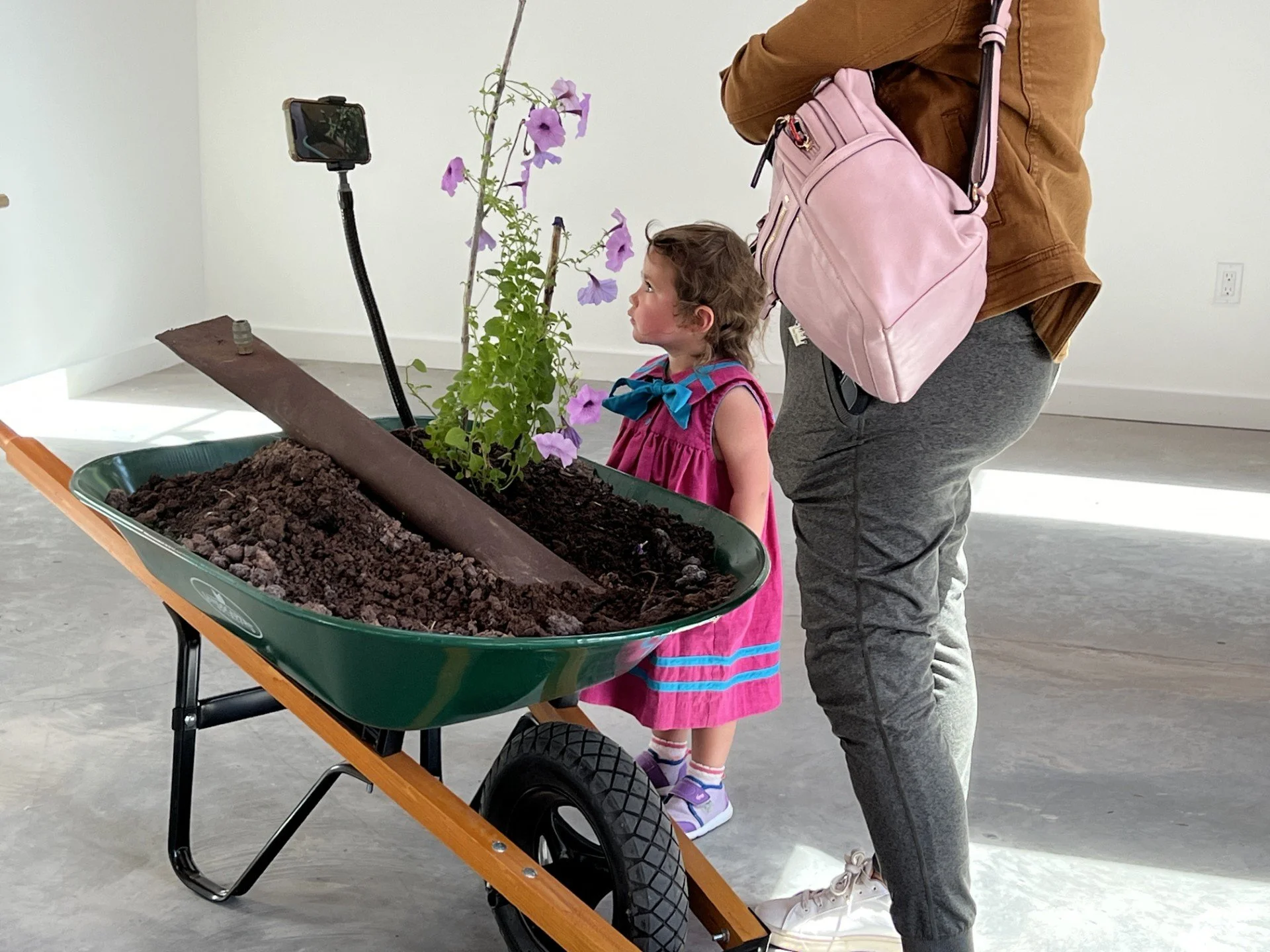
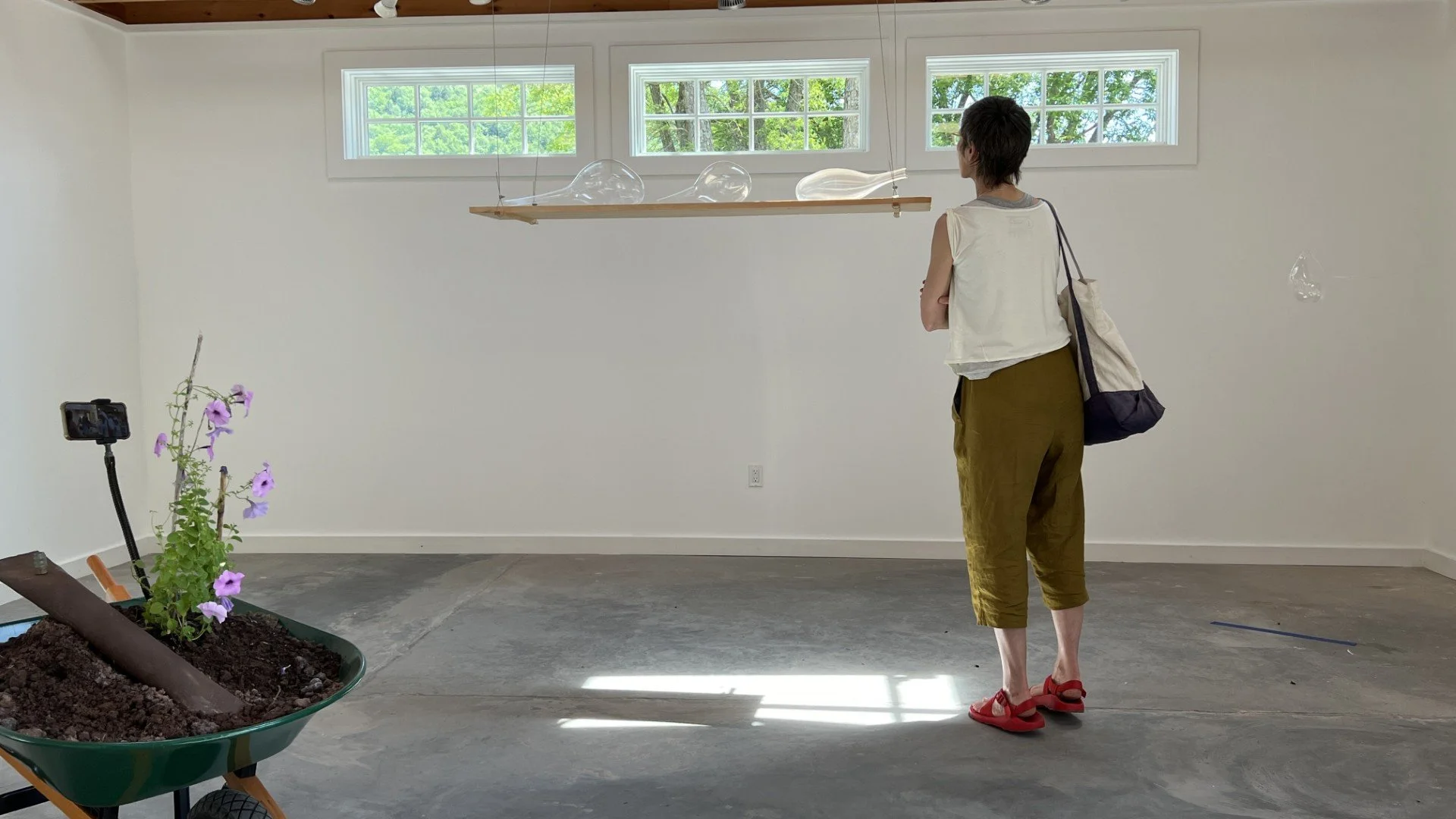
Birdsong Exhibition
-
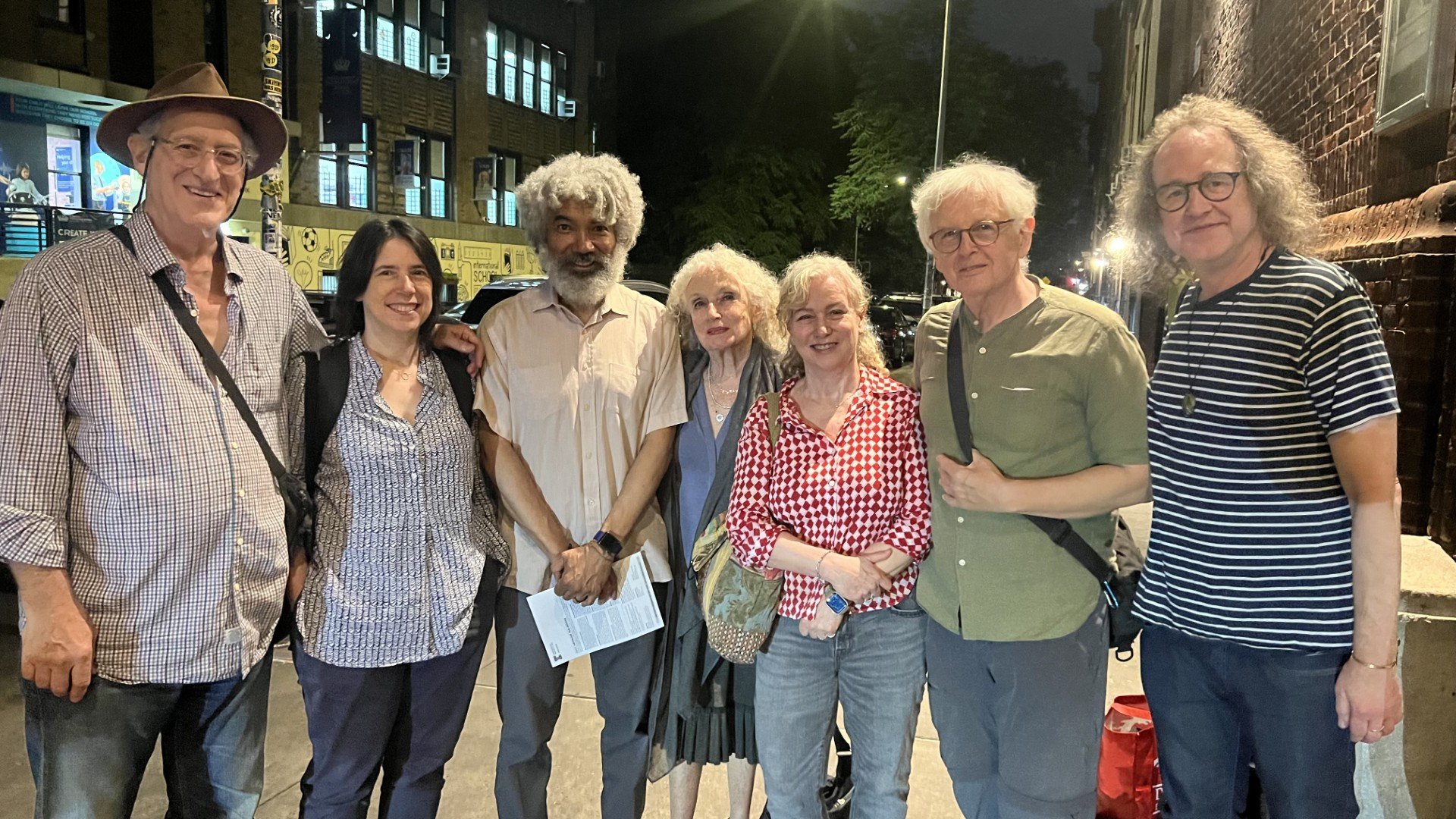
Beuys Transformer evening
(L-R) John DiLeva Halpern, Elaine Angelopoulos, Fred Wison, Kathy Brew, Melody London, Ron Rocco
-
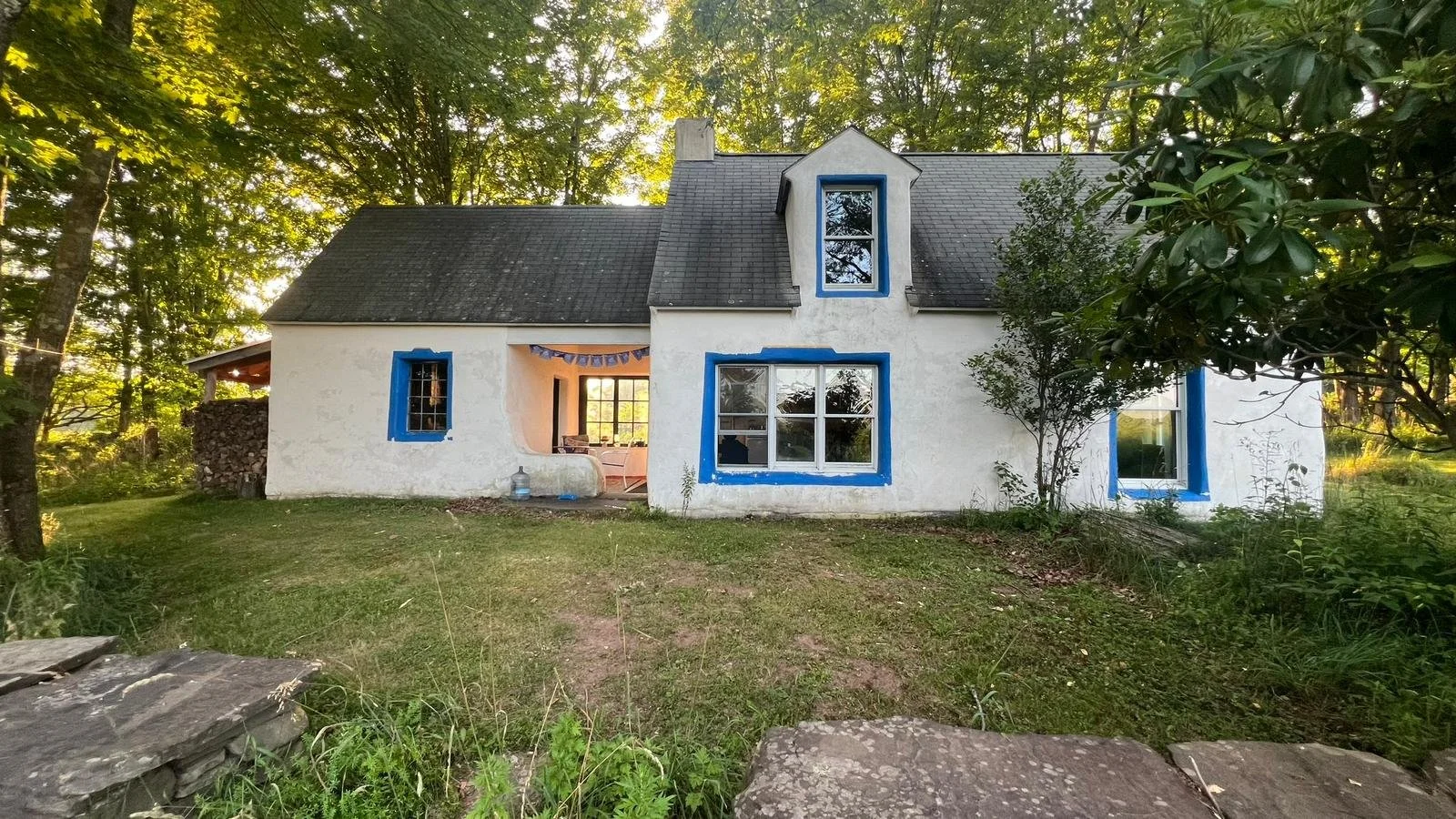
Jade Lake Meditation Retreat
-
![]()
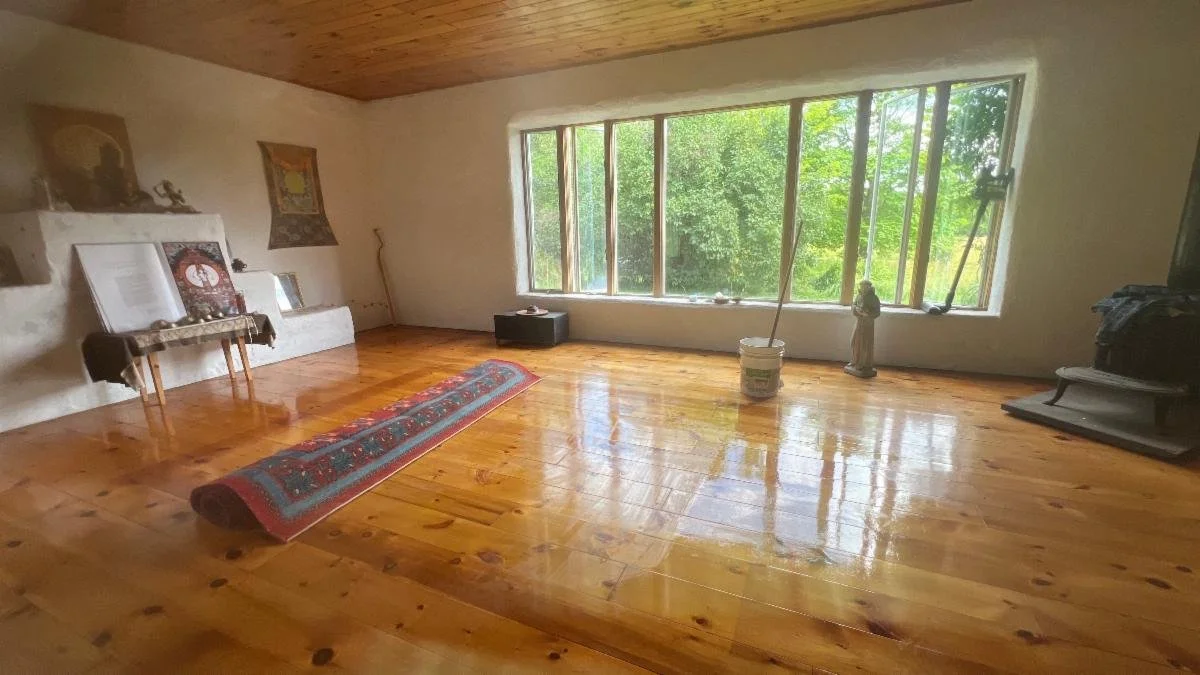
Gompa Cleanup
Getting ready for the retreat
-
![]()
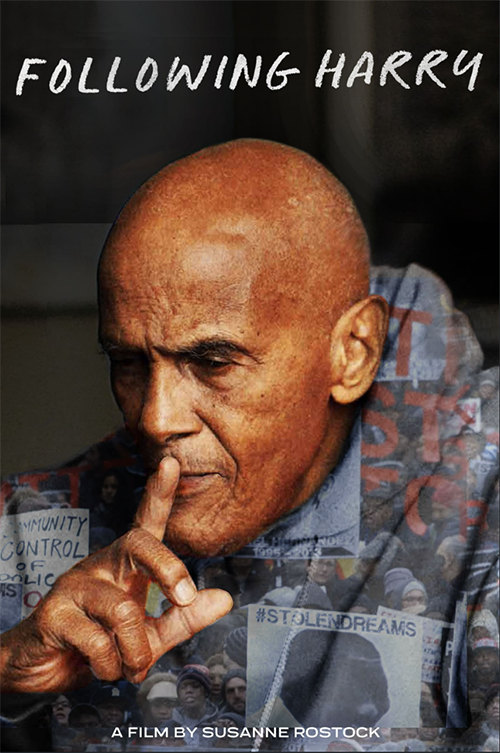
Following Harry by Susanne Rostock
-
![]()
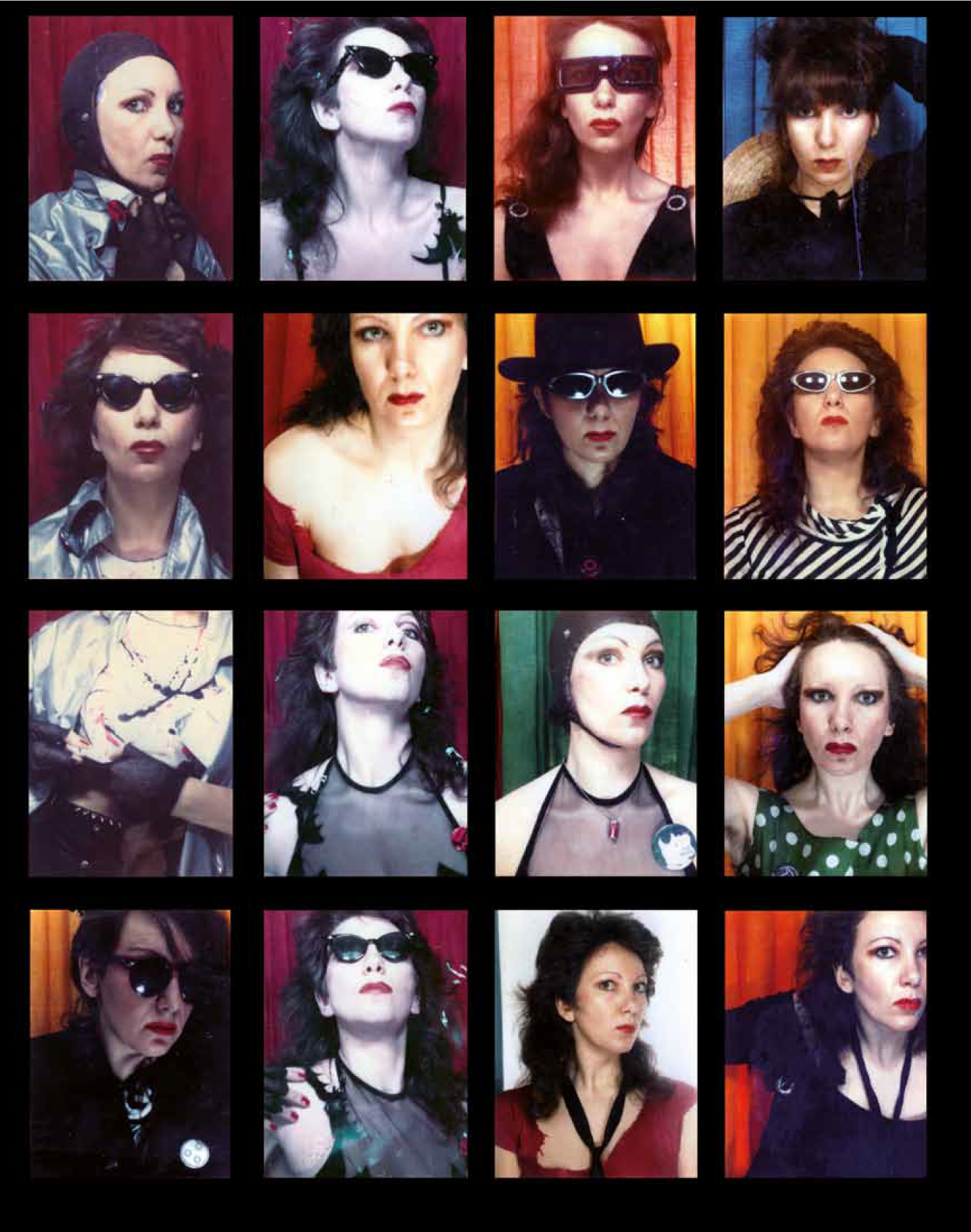
Babeth Mondini-VanLoo
-
![]()
Sunflower Plasma & {Alien] Stardust
-
![]()
The Mountain Eagle
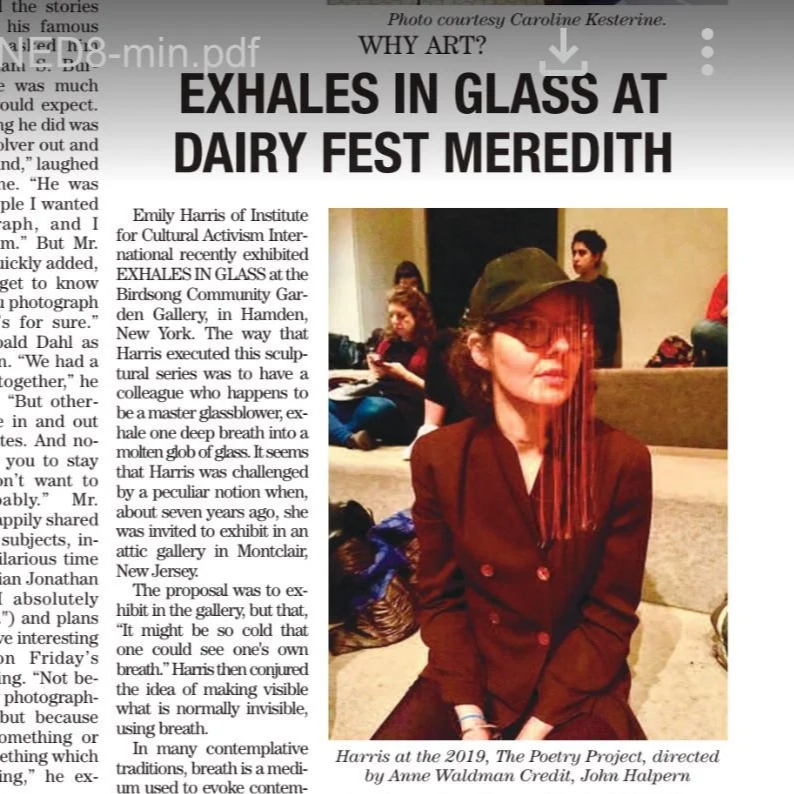
Article in WHY ART?
“Exhales in Glass at Dairy Fest Meredith, NY -
Birdsong Exhibition
-
Meredith Dairy Fest
-
Meredith Dairy Fest
-
Shinè Meditation
-
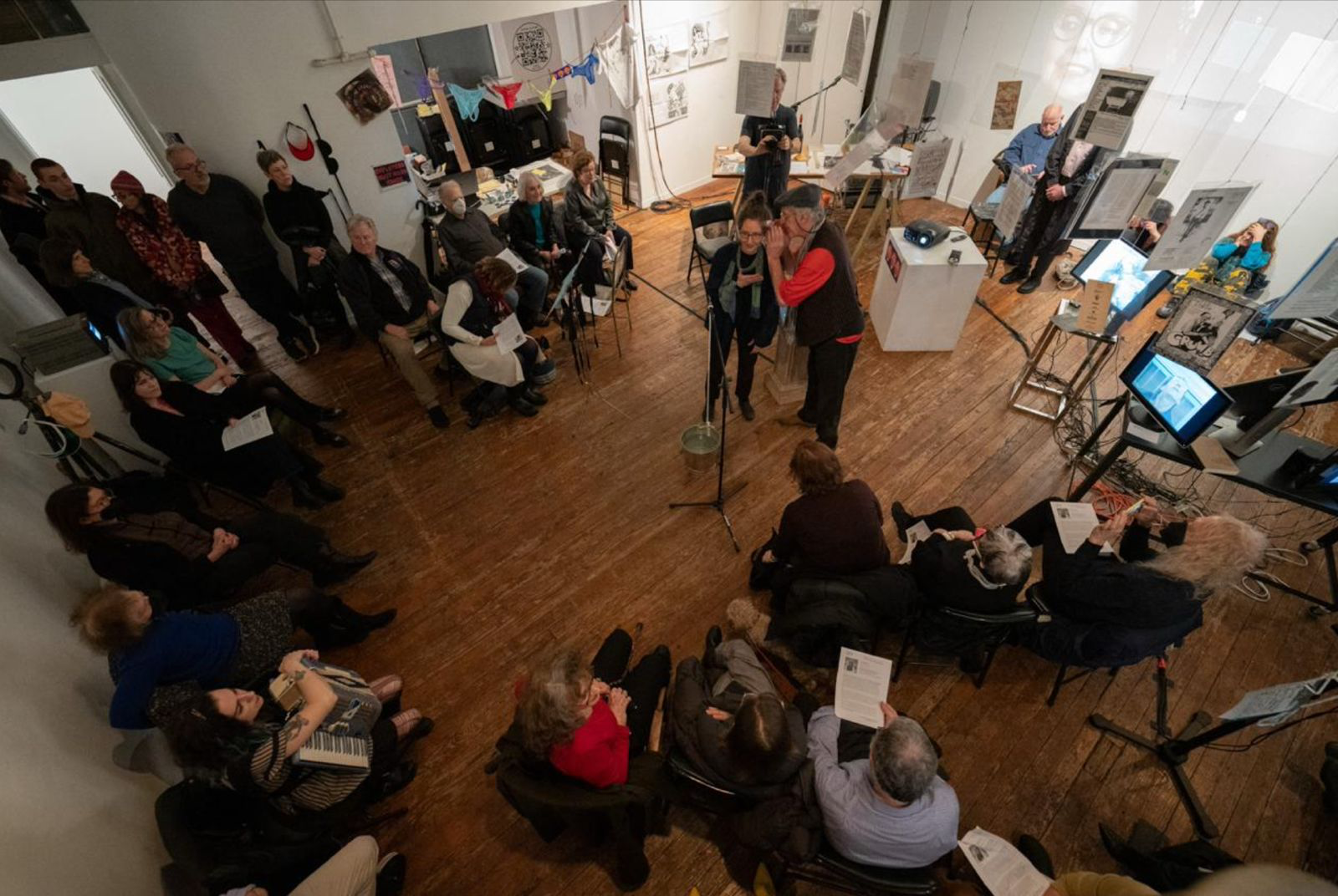
Robert Filliou: Assemblage du Film – DIY is a hybrid cinematic sculpture, installation, and performance presented by the Institute for Cultural Activism International at the Emily Harvey Foundation, premiering across two evenings in March 2024. Conceived as an immersive assembly of a film in progress, the work echoes Robert Filliou’s DIY bricolage methods—unfolding through multi-screen projections, overlapping sound, live performers, shadow play, doubling, and re-enactment. Rather than presenting a completed cinematic object, the installation remains deliberately unfinished, allowing film, performance, and sculptural elements to coexist in a continuous state of becoming flux.
Cast & Creative Team: Camera/Editors: Erin Taylor Kennedy, Andy French, Micael Preysler; Director/Performer: John DiLeva Halpern; Live Musical Performance: Melissa Elledge (Accordian); Live Performers: Elaine Angelopoulos, Dan Cameron, Jaanika Peerna, Katie Rashid, Daniel Subkoff, Kim Marrero, Jim Mereweather, Sharon Vatsky, Elena Zucker; Producer & Creative Director: Emily Marie Harris; Sound contributions & Technical Assistance: David Rothenberg, Schuyler Schwarz; Studio Assistants: Dante Fontani; Support: Ryan Cahill (US) and Annie Bloch (FR); Writing: Jacquelynn Bass, Dan Cameron, Martin Patrick
Special Thanks: Peter Freeman, Inc., Maryanne Filliou, Marceline Filliou, Katie Rashid, Emily Schechter, Anne-Laure Riboulet, and Christian XatrecFilliou’s life itself traced a quietly radical path beneath official histories: from underground experiences during the French Resistance, to working as a Coca-Cola truck driver, to writing for the United Nations’ postwar reconstruction efforts in South Korea. These shifts between labor, politics, art, and reflection were not contradictions but expressions of a single inquiry into how life and creativity interpenetrate. His collaborations with figures such as George Brecht helped shape a Fluxus-adjacent practice grounded in events, games, and instructions—artworks that functioned less as objects than, as Filliou said, “mind benders”.
At the core of Assemblage du Film – DIY is this lightly held worldview, transmitted through animated interviews with Marianne and Marcelline Filliou alongside archival voices and presences from a constellation of artists including Christo, Jean Dupuy, Dick Higgins, Alison Knowles, Dorothy Iannone, Allan Kaprow, Carolee Schneemann, Daniel Spoerri, and Emmett Williams. These fragments circulate across screens and space, evoking Fillious’ concept of the “Eternal Network” and French Nouveau Réalisme while foregrounding Filliou’s lifelong commitment to play, impermanence, and collective authorship. Viewers are placed inside a participatory field rather than positioned before a fixed historical narrative.
Developed by John DiLeva Halpern in collaboration with Emily Marie Harris, the project is closely intertwined with Halpern’s ongoing feature-length film Touch the Sky, a cinematic portrait of Filliou named after one of the artist’s own video works produced during his Canadian residencies in the 1970s. As with Halpern’s earlier collaboration with Joseph Beuys, the film approaches its subject through intimacy and relation rather than explanation—allowing Filliou’s presence to emerge through testimony, memory, and lived connection.
Filliou’s embrace of Buddhist-informed ideas—particularly impermanence, interdependency, and non-attachment—quietly shaped both his art and his life. This orientation culminated in his voluntary withdrawal into a three-year silent retreat in the Dordogne, France, undertaken as a final life-art gesture. It was during and after this period that Halpern came to know Filliou’s remaining family intimately, grounding Assemblage du Film – DIY not only in archival research but in continuity, trust, and ethical accountability.
In advancing this project, ICAI’s priorities are not illustrated but enacted. The work treats culture itself as a medium of change, operating through shared attention rather than a narrative story. It embodies ICAI’s commitment to social practice and participatory authorship, dissolving boundaries between artist, audience, and community. The installation integrates contemplative awareness into its very structure—encouraging slowness, listening, and non-reactive perception without formal instruction. It presents art history as a living lineage, activated through fragments, voices, and relationships rather than canonization. And by situating a relational, process-based strategy at the Emily Harvey Foundation while extending ICAI’s broader local–global cultural ecosystem, it affirms art’s role as social infrastructure—a stabilizing, connective force in times of fragmentation.
Writing on the project, Jacquelynn Baas has described Assemblage du Film – DIY as a “welcome salvage operation,” reviving the social energies and subtle intelligence of one of modern art’s most luminous yet elusive figures. Martin Patrick characterizes the installation as an intentional “destruction of a film in progress,” where multiple voices and temporalities coexist simultaneously, allowing a holistic, séance-like encounter with Filliou’s legacy to emerge through fragments rather than synthesis.
Within the context of the Emily Harvey Foundation—long a site of Fluxus continuity and experimental hospitality—the project functioned as a temporary commons where film, objects, performance, and audience presence intermingled. Here, Filliou’s quiet proposition that “art is what makes life more interesting than art” was allowed to operate with rigor and restraint: the work receded, and what remained was the quality of shared time, attention, and interdependent experience unfolding vibrantly in the room.
-
Tuning Fork Live is a live public interview series inviting cultural activists from around the world to share their work, motivations, sensibilities, and methods. 90-minute encounters provide dialogues between guests and audiences. The series explores collective capacities and strategies for enduring cultural change, analyzing diverse methods of “cultural activism” while growing a global network of engaged practices and scholarship. The TFL cultivates awareness as the medium for social change, treating conversation as cultural infrastructure for synthesizing just and resilient futures.
John Halpern, interviewer. Emily Harris, producer. Halpern has interviewed cultural icons: Joseph Beuys, Martin Scorsese, Matthieu Riccard, Melissa Mathison, Jetsunma Tenzin Palmo, H. H. the Dalai Lama, Oliver Stone, Allan Kaprow, Carolee Schneeman, Christo as well as infamous ex-terrorist Kashmiri freedom fighters, Native Americans on the U.S. border and persons in the street. His journalism has appeared in The Huffington Post in broadcast media and in print and radio, throughout his 50-yr career.TUNING FORK FM is a regional radio platform rooted in cultural activism that treats conversation, listening, and shared inquiry as forms of social practice.
For Delaware County, New York, TUNING FORK FM provided a vital cultural benefit by linking place-based experience with regional and global conversations. The program documented and amplified local cultural life in 2024—elevating regional voices, broadcasting public programs, and fostering cross-silo connections among artists, residents, educators, libraries, and civic spaces. In a rural context where access to cultural platforms is limited, TUNING FORK FM strengthened cultural vitality, reinforced community identity, and positioned Delaware County as an active participant in contemporary cultural discourse. Through radio as an inclusive and accessible medium, the program supported civic reflection, creative exchange, and long-term cultural resilience.In 2024, the program functioned as a connective cultural spine for exhibitions, film screenings, public programs, and live gatherings—broadcasting dialogues with artists, filmmakers, educators, and cultural thinkers working at the intersection of creativity, ethics, contemplation, and social engagement. Rather than operating as a promotional or opinion-based platform, TUNING FORK FM emphasized attention, perception, and interdependency, framing radio itself as an artistic and pedagogical medium capable of holding complexity, uncertainty, and reflection.
Throughout its 2024 programming, TUNING FORK FM operated as a stabilizing cultural infrastructure in a time of increasing polarization and informational saturation. By creating space for slow conversation, deep listening, and analytic inquiry, the program countered fragmentation and reactive discourse, supporting collective sense-making and imaginative agency. Broadcasts connected local events to broader cultural and historical contexts, treating dialogue as a living archive and an active form of cultural care rather than passive content delivery.
-
Tuning Fork Live – Episode 42 features a deep, reflective conversation with Fred Wilson, unfolding as both intimate exchange and far-reaching inquiry into perception, power inequities/dynamics, and market driven aesthetics. Recorded live as the first episode of 2024, the conversation takes place within the distinctive Tuning Fork Live format—a casual and open atmosphere of sharing a meal with friends - which consistently defines the series. What begins as a reunion among longtime peers expands into a sustained examination of how lived experience—particularly early encounters with difference—cultivates an artist’s capacity to read social systems from the inside out.
Wilson traces formative experiences from growing up as the only Black child in a suburban Westchester school to his radical education at SUNY Purchase, describing how early awareness of social positioning sharpened his sensitivity to what institutions communicate silently. These insights flow directly into his landmark institutional interventions, most notably Mining the Museum, where objects long relegated to storage are brought into charged proximity—silverware placed beside slave shackles, heroic busts set against empty pedestals bearing the names of absent Black historical figures. As Wilson articulates in the episode, the work is not about provocation for its own sake, but revelation: making visible what has always been present yet structurally unseen. Once something is seen, he notes, it cannot be unseen; perception alters the institution itself.
Throughout the episode, imagery emerges as an act of unveiling. Paintings are rearranged so peripheral figures step into focus; torn canvases are animated by whispered voices; lighting activates only when a viewer steps forward, implicating the body in the act of seeing. Wilson speaks of museums as systems trained to narrow attention—and of his role as one who loosens that grip, creating conditions in which meaning shifts irreversibly. The conversation moves fluidly across geographies, from Baltimore to Venice, where his work at the Venice Biennale draws submerged Black presences out of European art history and into contemporary consciousness. Chandeliers turn black, classical figures are reframed, and Shakespeare’s Othello becomes both anchor and mirror. Personal history enters as well, as Wilson reflects on works made during his father’s final years.
Wilson’s methodology—working inside institutions to reveal their hidden logics—resonates directly with ICAI’s core premise that culture itself is a primary site of power and transformation. The episode’s emphasis on attention, perception, and ethical responsibility mirrors ICAI’s approach to programming, where conversation, listening, and shared inquiry are treated as forms of social practice, new aesthetics and cultural infrastructure.
The dialogue also reflects long-standing affinities between Wilson’s work and ICAI’s founders and board members, including John DiLeva Halpern and Emily Marie Harris. Episode 42 thus reads as a convergence point within a shared lineage of conceptual art, institutional critique, and socially engaged practice.
As part of the 2024 Tuning Fork Live season, the Fred Wilson episode exemplifies the series’ role as a stabilizing cultural infrastructure—countering polarization and superficial discourse by holding space for reflective dialogue and collective sense-making.
-
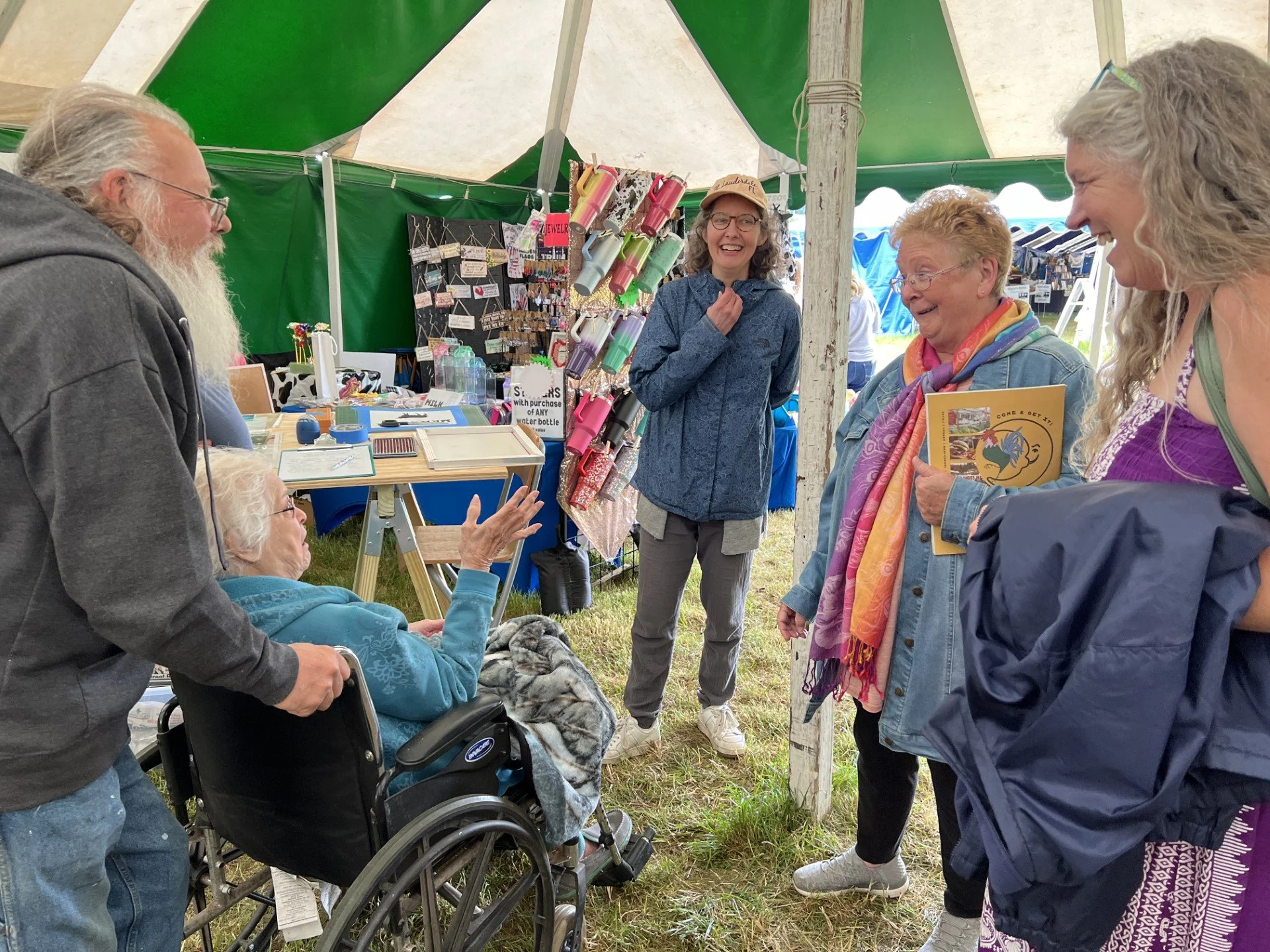
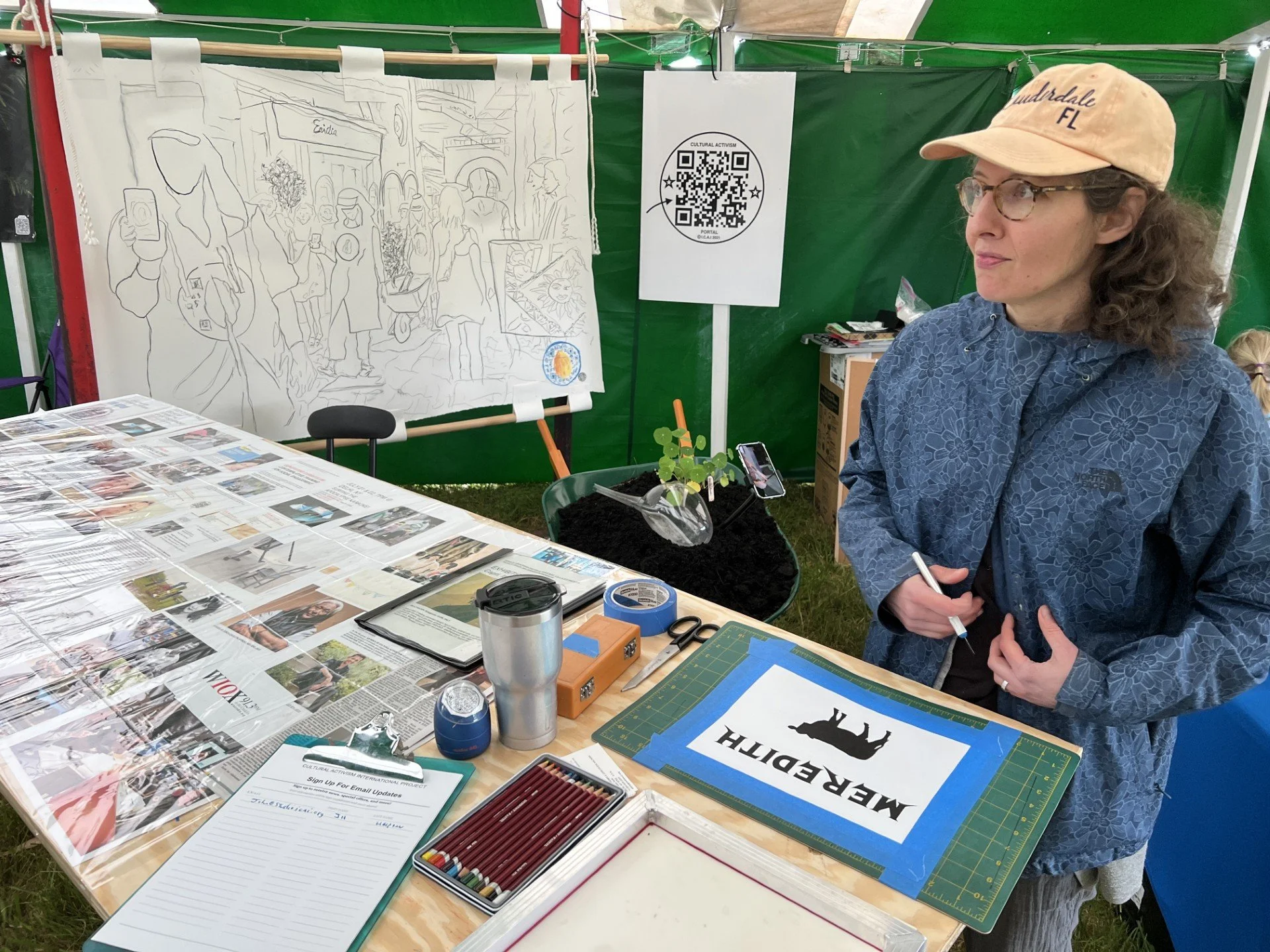
At the 2024 Meredith Dairy Fest in Meredith, New York—a celebration of dairy heritage, local agriculture, and community life took place June 8–9 as part of Delaware County’s Dairy Month festivities—the Institute for Cultural Activism International (ICAI) brought its public-facing arts and cultural activism practice into the heart of the event through an installation and participatory stand led by ICAI founder/collaborator Emily M. Harris.
Positioned among local vendors and farm demonstrations, ICAI’s presence emphasized creative engagement with regional culture by inviting festival attendees to interact with installation elements, explore silk-screen making, and contemplate the interdependence of community, land, and cultural expression in a rural festival context. This engagement reflected ICAI’s broader mission of merging social practice art with everyday cultural life—merging activist aesthetics independent of conventional gallery spaces, into grassroots celebrations of local history, ecology, and creative networks.
The ICAI booth held screen printing demos using direct transfer with hand cut paper stencils. Meredith t-shirts – stenciled in “Megadeth” font - were screen printed and for sale.
The booth was across from an opioid pill factory recruiting stand and next to a man who made chainsaw art and his two girls who brandished designs into cut leather that they made into stylish earrings and bracelets. -
An Evening with BEUYS — Anthology Film Archives, June 13, 2024
The 2024 Anthology Film Archives screening of JOSEPH BEUYS / TRANSFORMER was conceived as a cultural convening that reactivated a living historical network rather than presenting the film as a closed chapter of art history. TRANSFORMER was made at the end of the 1970s, a moment when organizations such as Art Corporation of America Inc., Colab, and ABC No Rio were in active dialogue with one another—and in direct contact with Joseph Beuys. This period marked an intense convergence of experimental art, political urgency, and alternative institutional models in New York, roundly informed by Beuys’ evolving ideas of Social Sculpture and the Free International University. The 2024 screening was deliberately conceived to bring these historically connected groups—many still active in Manhattan—back into shared space, not as a commemoration, but as a contemporary reassembly.
Crucially, TRANSFORMER is a film/art event about an artist, made by artists. Conceived and directed by John DiLeva Halpern, the work emerged from a core creative team that included artist Les Levine as Video Design Consultant and composer Michael Galasso, whose score functions not as accompaniment but as an integral sculptural layer of the work. TRANSFORMER operates as an artist-to-artist transmission—extending Beuys’ pedagogical and aesthetic practice into the medium of film itself. The result is a cinematic form that treats moving image, sound, gesture, and conversation as sculptural materials capable of shaping perception, consciousness, and ethical imagination.
TRANSFORMER was screened at Anthology Film Archives, New York’s historic avant-garde film center, as a strategic act of cultural convening. Anthology was chosen for its legacy in experimental cinema, and as a symbolic and practical meeting ground capable of energizing an assembly of cultural shape-shifters—artists, educators, curators, and organizers working across academic, grassroots, and institutional spaces. Held in Anthology’s large theater, the evening was structured as a time-based social artwork designed to activate participation across generations and institutional boundaries. The one-hour film—the only real-time work made during Beuys’ 1979–80 Guggenheim exhibition—was presented alongside multiscreen interview fragments from Beuys’ original Guggenheim entourage, visible upon entering and exiting the theater, surrounding viewers with institutional memory and living voices from the period.
The screening expanded into a live Q & A discourse through a panel discussion featuring Carin Kuoni, Ernesto Pujol, John DiLeva Halpern, and moderated by Elaine Angelopoulos. All panelists actively engage in cultural activism within both academic and art-institutional contexts, working at the intersection of pedagogy, social practice, and institutional critique. The ensuing town-hall-style exchange transformed the theater into a civic space of shared inquiry, echoing the conversations that shaped the film’s making more than four decades earlier.
The evening concluded with a wine reception—a gathering of community members, artists, scholars, longtime collaborators, and friends—that extended the work beyond the screen into embodied social exchange. This closing moment affirmed the event’s central intention: to treat the screening as a living convergence of artists, institutions, and publics, not a retrospective. Framed within the ongoing work of the Institute for Cultural Activism International, the Anthology event demonstrated how TRANSFORMER continues to function as a catalytic cultural instrument—capable of reconnecting past and present networks, activating participation, and reaffirming culture itself as a viable medium for institutional transformation, collective imagination, and shared celebration.
Thank you to Elaine Angelopoulos for curating the evening panel, Carin Kuoni for her insightful contributions, Ron Feldman and the Feldman Gallery, Babeth Mondini-Van Loo and the technical film team at Anthology Film Archive. -
The Tuning Fork Live - Episode 42 with Babeth Mondini-Vanloo can be understood as a cultural-activist performative auto-biography—a living articulation of a life practiced as Social Sculpture. As a direct student and long-term collaborator of Joseph Beuys, Mondini-Vanloo does not describe Beuys’ ideas from a distance; she enacts them. Structured through a sequence of 108 images, the episode replaces narrative chronology with cyclical return, mirroring contemplative and Buddhist-informed modes of knowing in which meaning accumulates through repetition, attention, and relational presence. The episode itself functions as a sculptural act—time-based, relational, and pedagogical.
Mondini-Vanloo frames her life practice as service-oriented cultural labor, aligned with the original mandate of the Free International University (FIU): to merge education, ethics, and social responsibility into everyday life. Her story unfolds not through personal milestones, but through methods—ways of listening, organizing, transmitting, and holding space. This approach implicitly infers a Buddhist socially engaged model, where awareness is inseparable from action and where inner cultivation directly conditions collective structures.
At the conceptual core of the episode is Mondini-Vanloo’s book Art = Life = Art From Beuys To Buddhism, which operates as a lived vow. The book—and the episode—assert that art is not an object, profession, or event, but a continuous ethical posture enacted through daily choices, relationships, and gestures. In this sense, the TUNING FORK episode becomes an act of cultural transmission: an embodied record of how Beuys’ Social Sculpture evolves when filtered through Buddhist-inflected practices of mindfulness, non-attachment, and compassion—positioning cultural activism as a lifelong, disciplined practice of shaping society from the inside out.
-
From August 16–18, 2024, the Art of Mind: Calm Abiding Retreat took place at Jade Lake Retreat Center in East Meredith, New York, led by John DiLeva Halpern and hosted by Yemana Sanders. Inherent to the mission and aesthetic ethos of the Institute for Cultural Activism International (ICAI), the retreat was structured as a 15-hour, three-day course exploring the organic fluidity required to navigate three interrelated Calm Abiding (Shiné) methods as a disciplined training of attention essential to social engagement and cultural work.
TESTIMONIALS
Brilliant and I will try this. You know, that was my first ever formal introduction to Shiné. Also the first time I learned of sun and moon in the fists in breath purification. I skipped basics; only now making a point of pointed fill-ins of my multitude of cracks🧐 ~ Retreat ParticipantCentral to the retreat was the recognition that industrial society is sustained not only by external systems, but by internalized, hyperbolic social conditioning: speed, reactivity, identity fixation, and “OS”-like behavior. Shiné was presented as a means of deconstructing this paradigm from the inside out, making conditioned mental processes and actions visible through subtle attention learning. As attention stabilizes, participants directly encountered an experiential awareness of interdependency and interconnectivity, revealing how inner mental processes and outer material conditions continuously co-arise.
Through yogic breathing disciplines, seated meditation, walking meditation, and reflective dialogue, participants applied this organic fluidity while moving between the three Shiné methods, exploring somatic and neuro-perceptual sensations of emptiness as bodily experience rather than abstraction. A defining quality of the experiential learning was the natural “unknotting” of inner turmoil and physical tension, as layers of conditioned behavior softened and unraveled. These learned capacities—stability, non-reactivity, and embodied clarity—were explicitly framed as building resilience to hyperbolic social conditioning, enabling participants to remain responsive rather than overwhelmed by amplified narratives and pressures.
Contemplative awareness was framed as a relational and neurological process shaping perception, decision-making, and ethical action. From this perspective, engagement arises less from reaction or ideology and more from discernment grounded in lived interdependence.
Practice extended naturally into daily activities and group exchange, reinforcing ICAI’s principle that contemplation and cultural practice are inseparable. In resonance with ICAI’s mission, the retreat positioned Calm Abiding as infrastructure for cultural activism—supporting forms of engagement that resist reproducing industrial paradigms of domination and instead cultivate responsive, ethical participation grounded in clarity, care, and collective responsibility.
-
DEEP SEEING: Photography Workshop with Ed Heckerman, held on October 20, 2024 at Jade Lake Retreat Center in East Meredith, New York, formed part of Institute for Cultural Activism International’s ongoing contemplative programming—an integrated framework that situates artistic practice as a method for ethical attention and interdependent awareness. Rooted in Heckerman’s approach of slowing perception and releasing aggressive intent, the workshop invited participants to engage photography as a contemplative discipline rather than a technical pursuit. Walking quietly through the landscape with cameras held lightly, participants practiced sustained attention to light, form, and environment, cultivating a mode of seeing that emphasizes relationship over extraction and presence over capture.
Within ICAI’s broader commitment to cultural activism, DEEP SEEING functioned as a practical inquiry into how perception itself shapes social and ecological responsibility. Photography was framed as a way of being—where noticing becomes an interconnected act and image-making becomes a record of relational awareness rather than visual consumption. Participants were guided to noticing their habitual assumptions and cultural noise, allowing images to arise from lived encounter and mutual presence. In this context, Heckerman’s workshop advanced ICAI’s art-of-conscience methodology: using contemplative practice to train sensitivity to interdependence, deepen accountability to place, and reaffirm art’s capacity to shape how individuals perceive, relate, and interact within a shared world.
-
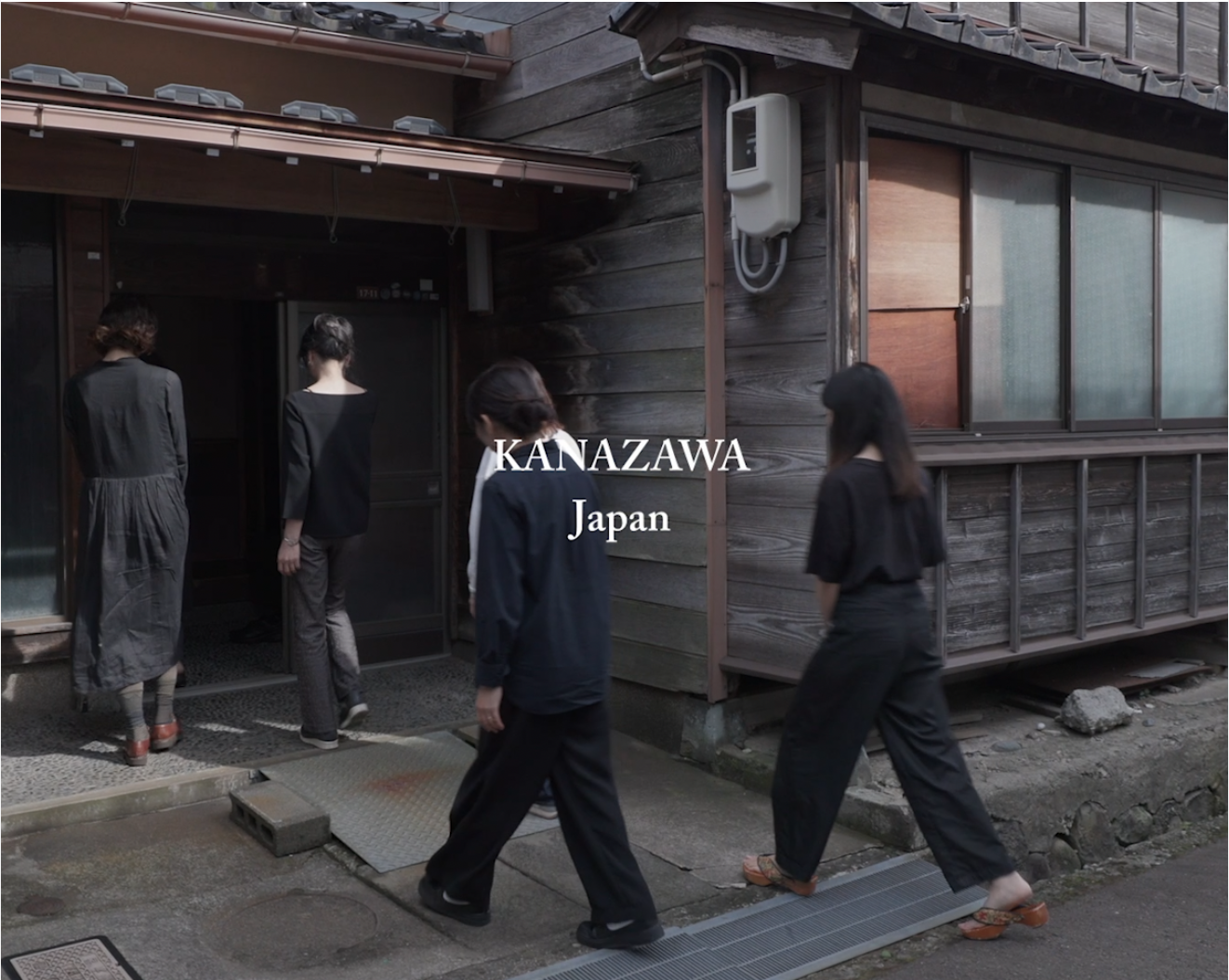
Tuning Fork Live – Episode 45: Salon d’Amour in Japanfunctions as the second Salon d’Amour episode within the Tuning Fork series, extending the project’s evolving performative and cultural-activist trajectory. Broadcast live between New York and Kanazawa, Japan, the episode centers on a multi-site exhibition and participatory performance unfolding within vacant houses across the city. Led by Margaret Wibmer—an active collaborator and board member of the Institute for Cultural Activism International (ICAI)—Salon d’Amour is presented not only as an artwork but as a social structure, embedded within a broader initiative addressing depopulation, memory, and the reuse of neglected domestic space. Artists, curators, architects, and local translators join the conversation to describe how abandoned homes become temporary stages for performance, sound, ritual, and encounter, inviting visitors to navigate the city without maps and discover works through presence and chance.
At the core of the episode is Wibmer’s Salon d’Amour, a participatory performance in which masked and unmasked participants read love letters, poems, and literary excerpts aloud to one another, generating layered soundscapes of intimacy, vulnerability, and dissonance. The discussion explores how the work transformed within a Japanese cultural context, where the concept of ma—the space between—reoriented bodily distance, listening, and social codes. Importantly, the live Zoom audience for this episode included individuals who had directly participated in Salon d’Amour in Japan, allowing the conversation to be informed not only by curatorial reflection but by embodied experience. Their presence folded lived memory and participant testimony back into the work’s evolving social field.
Positioned as a precursor to Wibmer’s forthcoming 2025 Salon d’Amour exhibition at Birdsong Community Garden Gallery (August 2025), Episode 45 documents a critical phase in the project’s development. Salon d’Amour in Japan is framed as cultural activism in practice—an “underground monument” that resists spectacle in favor of slow engagement, community exchange, and lived experience. Moving fluidly between literary archive, architecture, sound, and social ritual, the episode reveals how art can function as social infrastructure, bridging inner life and collective space. In doing so, it situates Salon d’Amour as an evolving methodology—one that deepens through collaboration, participation, and context, culminating in its next iteration at Birdsong.
11月8日(金)Margret Wibmer(マーグレット・ヴィブマー)氏 協力:オーストリア大使館・オーストリア文化フォーラムコンセプチュアル・アーティスト。ニューヨークでソル・ルウィットのアシスタントを務めた後、アムステルダムに拠点を移し、現在に至る。さまざまなメディアを通して、身体、物、空間の関係を探求しており、中でもテキスタイルは彼女の芸術活動において重要な素材であり続けている。パレ・ド・トーキョー(パリ)、RMITデザインハブ(メルボルン)、アウデ・ケルク(アムステルダム)などの著名な会場で展示されている他、2010年からは、金沢を拠点に活動するアーティストでキュレーターの中森あかねとコラボレーションを行い、石川県西田幾多郎記念哲学館で初演された「Absence of the teamaster」をはじめ、茶人の小堀芙由子やダンサーの山下きよみとヨーロッパで公演を行った。彼女の作品に関する論文がKerber VerlagとVfmKから出版されている。Nanyang Academy of Fine Arts (NAFA)シンガポールで非常勤講師を務め、米国を拠点とするInstitute for Cultural Activism Internationalの協力者であり、理事も務める。
In collaboration w Austrian Embassy/Austrian Cultural Forum Tokyo & Institute for Cultural Activism International TUNING FORK LIVE special JAPAN with Akane Nakamori, Hirotaka Sato, Sae Shimizu, Margret Wibmer a.o.
Nov 3rd 6:30 pm New York (EST) / Nov 4th 8:30 am (Japan)
SALON D’AMOUR by MARGRET WIBMER at ‘Omukaino-ie’ house, Kikugawa area, Kanazawa, Japan, 2024. In collaboration with ’Tsuzuru’ for ‘A place that is vanishing while being born’ Curators: Akane Nakamori, Sae Shimizu. Assistant curator: Arisa Kasama. Concept, choreography, manuscript, masks: Margret Wibmer // Soundscape: Robert Poss; Sound design and engineering: Norihiro Mori; Photography, video and editing: Nik van der Giesen // Graphic design manuscript: PEACH Wien; Special contributions manuscript: Marianna Maruyama and Mohamedou Ould Slahi // Translations: Kagari Ishikawa; Performance assistants: Akane Nakamori, Sae Shimizu, Arisa Kasama, Louis Etoundi Menanga // Participants: the public. Supported by Housing and Community Foundation Shibuya Science, Culture and Sports Foundation, Istyle Art and Sports Foundation, Federal Ministry Republic of Austria - Arts, Culture, Civil Service and Sport. -
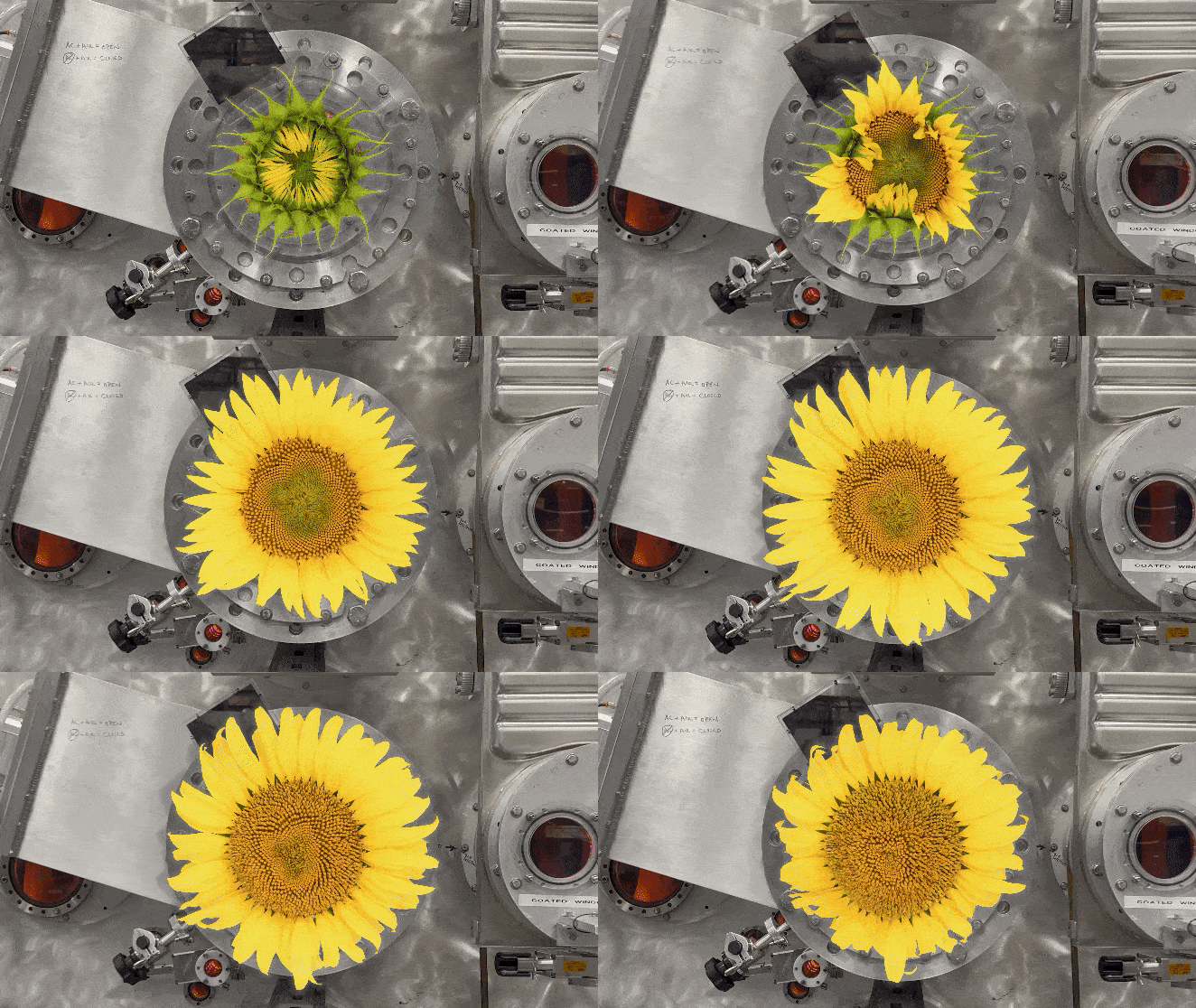
Tuning Fork Live – Episode 44: [SUN]Flower Plasma, co-presented with LEONARDO (a global network of transdisciplinary scholars, artists, scientists, technologists and thinkers, experimenting at the cutting-edge of art, science, and technology), offered Victoria Vesna, ICAI’s most recent board member (2024) and active collaborator, an opportunity to present [SUN]Flower Plasma as a work-in-progress, open to communal reflection, audience question and insight. The episode functioned as a critical incubation space—allowing scientific collaborators, ICAI participants, and audiences to engage the work as a living social sculpture.
Vesna’s [SUN]Flower Plasma juxtaposes the complexity of plasma physics with the biological intelligence of the sunflower, linking micro and macro systems to illuminate how energy circulates across cosmic, ecological, and social domains. This art sci project resulted from years of dialogue between Victoria Vesna and plasma physicist Dr. Walter Gekelman, an expert in Alfvén waves who built one of the largest plasma machines in the world, currently housed at UCLA. In addition to viewing materials from the plasma lab, we met biomedical engineer Dr. Haley Marks – Vesna’s collaborator - who captured sunflower parts, revealing their remarkable microscopic structures resembling the sun.
Vesna’s work exemplifies ICAI’s commitment to long-form inquiry that bridges scientific research, embodied perception, and ethical reflection within an interdisciplinary framework. Through this dialogic process, the conceptual and experiential dimensions of the work deepened, clarifying its role as a contemplative instrument for sensing interdependence and directly informing Vesna’s 2025 installation for ICAI’s Public Art for Dialogues, a public-facing, participatory multimedia work
[SUN]Flower Plasma is supported by the NEA, Bermant Foundation and nominated for the 2025 Ars Electronica S+T+ARTS Prize. The installation invites collective attunement to shared frequencies of living and stellar matter amid ecological disruption and social upheaval.
Discover more about this project on: 🔗 SUNFLOWERPLASMA.COM -
Tuning Fork Live – Episode 46 stands as a landmark ICAI episode, positioning both Following Harry and the Tuning Fork Live platform itself as advocacy-driven social instruments. The episode centers on activist filmmaker Susanne Rostock in conversation around her intimate portrait of Harry Belafonte. Filmed during the final chapter of his life. Belafonte in a pantheon of artist/activists, leverages his career and charisma for human rights. At age 96, Belafonte remains fully engaged—working alongside younger generations of organizers, reflecting on racial justice in the United States, and articulating a moral vision rooted in responsibility, courage, and intergenerational solidarity. Following Harry functions as a living pedagogical document—modeling how ethical leadership, cultural memory, and activism are carried forward through intergenerational and committed practice.
Within the episode, Rostock situates Following Harry as a continuation of her long-standing activist filmmaking methodology, extending the lineage established in Sing Your Song. Drawing on her background in ethnographic filmmaking and decades of editorial collaboration, she describes cinema as a tool for advocacy, education, and moral transmission—a medium that does not simply record social movements, but actively participates in them. Her approach foregrounds intimacy, listening, and sustained engagement, positioning film as a pedagogic structure capable of shaping consciousness, sustaining historical continuity, and cultivating responsibility across generations.
Framed within the Institute for Cultural Activism International’s Tuning Fork Live series, Episode 46 underscores the program itself as a complementary social-practice methodology. Like Rostock’s filmmaking, Tuning Fork Live operates as an advocacy platform—convening artists, activists, and audiences in real time to transform dialogue into shared civic learning. Together, Following Harry and this episode demonstrate ICAI’s core premise: that storytelling, conversation, evoking real creative intervention, and practicing attentive witnessing function as pedagogical infrastructures—training perception, transmitting values, and reinforcing the ethical capacities necessary for sustained social change.